

Guidance Articles
Using WhatsApp for Order Communication: Helpful Tool or Hidden Risk for Small Businesses
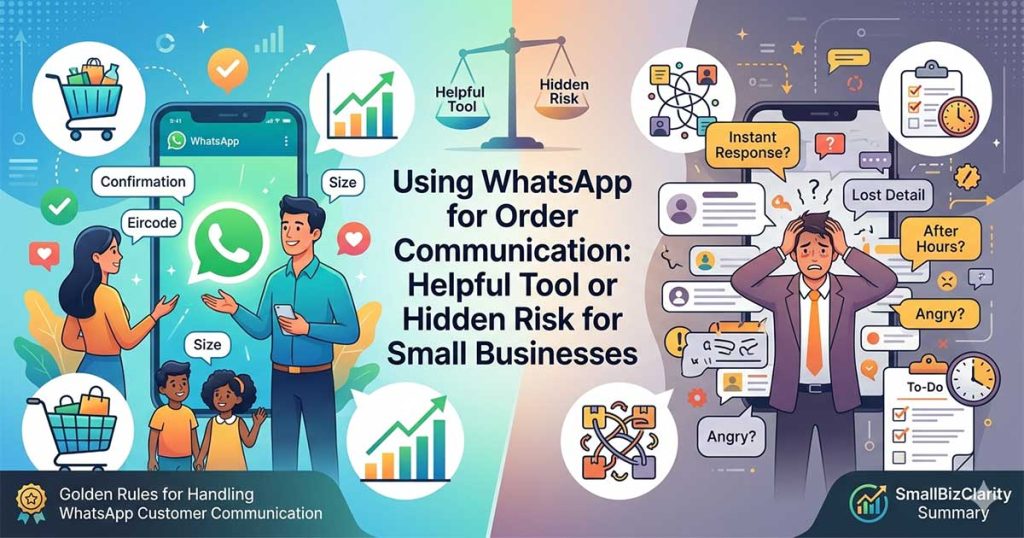
Using WhatsApp for Order Communication: Helpful Tool or Hidden Risk for Small Businesses?
By Seán – The Ecommerce Guy at Small Biz Clarity
For many small businesses, WhatsApp has become a default communication channel for customers. It is fast, familiar and feels more personal than email. Customers use it to ask about everything from Eircodes and delivery updates to personalisation details and order changes.
At first glance, this seems ideal. It removes friction, speeds up decision-making and helps customers feel supported. However, as many business owners discover during busy periods, WhatsApp also changes the nature of customer communication in ways that are not always positive.
Used well, it can improve conversion rates and reduce errors. Used without boundaries, it can remove structure, blur responsibility and increase pressure on the business owner.
This article explores the advantages and disadvantages of using WhatsApp for order communication, and how small businesses can use it effectively without losing control of their customer service process.
Why WhatsApp Works So Well for Order Communication
1. It removes friction from customer decisions
Customers often hesitate over small but important details such as:
- Eircodes and delivery confirmation
- Personalisation spelling and wording
- Product suitability or sizing
- Delivery timing and availability
A quick WhatsApp message can resolve uncertainty instantly. This often turns hesitation into a completed order within minutes.
For customers, the convenience is significant. For businesses, it can directly improve conversion rates.
2. It feels personal and reassuring
Unlike formal email exchanges, WhatsApp feels conversational and immediate. This creates a sense of accessibility and trust.
For small businesses selling handmade, personalised or high-consideration products, this reassurance can be a key differentiator.
3. It is ideal for clarifying order details
WhatsApp is particularly effective for quick clarification of details such as:
- Spelling and personalisation checks
- Address and Eircode confirmation
- Delivery instructions
- Quick reference photos or confirmations
When used correctly, it reduces the risk of errors and improves customer confidence.
4. It fits modern customer behaviour
Customers increasingly expect instant communication. WhatsApp fits naturally into everyday behaviour, allowing them to send quick questions between work, travel or family commitments.
This immediacy can significantly improve the customer experience when handled well.
The Hidden Downsides of WhatsApp Customer Communication
1. It removes the professional buffer
Email creates structure and distance. WhatsApp removes both.
While this makes communication faster, it also makes it more emotionally immediate. When something goes wrong, the message arrives directly and personally, often increasing tension.
Hi, this isn’t what I expected…
This creates pressure to respond instantly and can make issues feel more personal than they should be.
2. It creates expectations of constant availability
Customers often assume WhatsApp means instant response, regardless of time or workload.
This can lead to:
- Evening and weekend messages
- Interruptions during production or fulfilment
- Pressure to respond immediately
Over time, this can significantly impact work-life boundaries.
3. It increases the risk of lost or unstructured information
WhatsApp conversations are fast-moving and informal, which makes them easy to lose track of.
Important details such as:
- Final address or Eircode confirmation
- Personalisation approvals
- Delivery instructions
can easily become buried in chat history, increasing the risk of error.
4. It encourages informal agreements
Because WhatsApp feels conversational, customers may assume something has been confirmed when it has not been formally recorded.
This can lead to misunderstandings around:
- Delivery timing
- Custom requests
- Changes after ordering
Without a structured record linked to the order, clarity can be lost.
5. It bypasses your systems
When WhatsApp becomes the primary communication channel, customers often skip:
- FAQs and product information
- Checkout instructions
- Order confirmation details
This shifts workload from structured systems into direct messaging, increasing operational pressure.
Dealing With Annoyed Customers on WhatsApp
One of the most challenging aspects of WhatsApp communication is how quickly frustration can escalate when something goes wrong.
Because the channel is immediate and personal, complaints feel more direct and emotionally charged than email.
Managing this properly is essential to maintaining professionalism and avoiding escalation.
1. Acknowledge quickly, but don’t rush the solution
Hi, I’m really sorry to hear this. I’ve received your message and I’m just looking into it for you now.
This reduces tension without committing to a solution before the facts are checked.
2. Stay neutral, not reactive
Even if a message feels emotional or unfair, responding calmly and factually is essential.
Short, clear responses are more effective than detailed defensive explanations.
3. Move complex issues to email
Thanks for letting me know. I want to make sure I look into this properly for you, so I’ll follow up by email shortly.
This restores structure and gives space for proper resolution.
4. Ensure outcomes are recorded properly
WhatsApp should never be the final record of resolution. All key decisions should be documented in your order system or email trail.
5. Step back when needed
I completely understand your concern. To make sure I handle this properly, I’m going to continue this by email so everything is clear and documented.
This helps reset tone and prevents escalation.
🟨 Golden Rules for Handling WhatsApp Customer Communication (SmallBizClarity Summary)
- Acknowledge quickly — even if you don’t have the full answer yet
- Never mirror emotion — stay calm, neutral and professional
- Don’t resolve complex issues in WhatsApp — move them to email
- Avoid instant commitments — confirm only after checking facts
- Always document outcomes properly — WhatsApp is not your record system
- Use a reset line when needed — move conversation to email when appropriate
- Protect tone as much as time — professionalism under pressure matters
Best Practice: Using WhatsApp Without Losing Control
Keep WhatsApp focused on clarification
- Pre-order questions
- Address and Eircode confirmation
- Personalisation checks
- Quick delivery queries
Set expectations early
- State business hours for responses
- Clarify response times during busy periods
Always confirm key details in your system
- Order notes
- Email confirmations
- Internal records
Maintain boundaries
When issues become complex or emotional, email provides structure, clarity and a more appropriate communication environment.
Conclusion
WhatsApp has become a powerful tool for small business communication. It improves speed, reduces friction and helps customers feel supported throughout the buying process.
However, it also removes structure. Without clear boundaries, it can increase pressure, blur responsibility and make customer communication harder to manage.
The key is intentional use.
When used for quick clarification, WhatsApp enhances the customer experience. When used as a default support channel, it can undermine the systems that keep a business running smoothly.
The businesses that benefit most are not those that respond fastest — but those that maintain clarity, structure and control while still being accessible.