
Guidance Articles
E-levation Hub: Building a Personal Business Hub for the Way We Actually Work
E-levation Hub: Building a Personal Business Hub for the Way We Actually Work
We all have them.
A browser full of pinned tabs. A bookmarks folder with dozens — or hundreds — of saved links. One website for email, another for hosting, another for suppliers, another for payments, another for analytics and another for the tools we use every day.
And then, when you actually need something, you find yourself searching through all of them.
That was the problem I wanted to solve for myself.
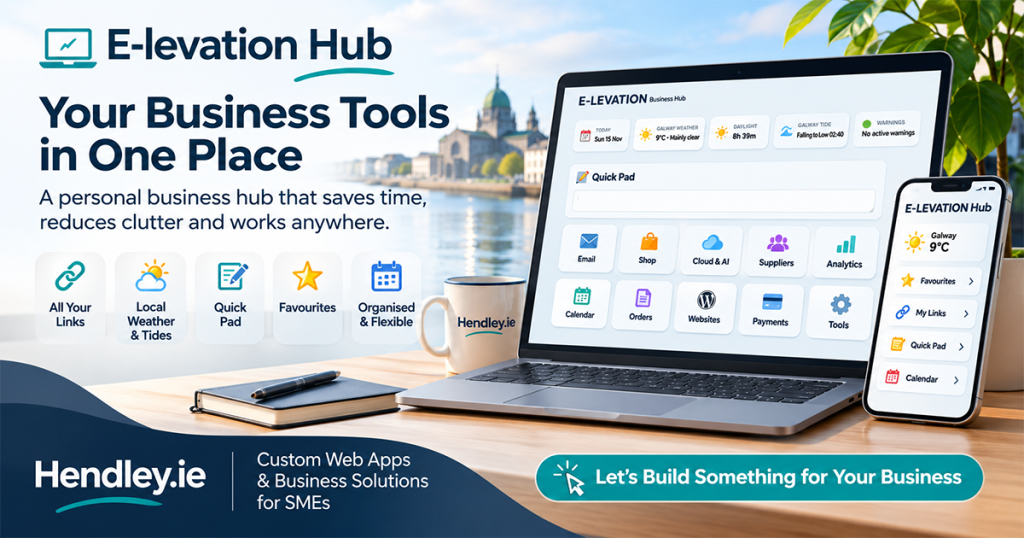
So I built E-levation Hub — a private, personal business hub that brings the websites, tools, information and resources I use regularly into one place.
It started as a simple idea. It has now become something I use as the starting point for my working day.
Why build another dashboard?
The objective wasn’t to create another complicated business management system.
There are already plenty of those.
I wanted something much simpler.
I wanted to open one web page and immediately have access to the things I use most often.
Instead of thinking:
“Where did I save that link?”
I wanted to think:
“It’s in the Hub.”
That distinction sounds small, but removing those little moments of searching and switching can make a surprisingly big difference when you’re working across multiple businesses, suppliers and online services.
Everything in one place
The E-levation Hub brings together my frequently used websites and services into a single, private interface.
It includes:
- ⭐ Favourites for the links I use most
- 🛍 ShopStreet supplier information
- 📧 Email and communications
- ☁️ Cloud and AI services
- 📰 News sources
- 🌐 My own websites and services
- 🔗 Business and productivity tools
- 🔎 Search across the Hub
- 📝 Quick Pad for temporary notes and information
The links can be organised into categories and rearranged directly on screen, so the Hub can evolve as the way I work changes.
It isn’t intended to be a replacement for the services themselves.
It’s the starting point for getting to them.
A little more than a bookmark manager
This is where the project became more interesting.
Once I had the basic launcher working, I realised that the page could also provide useful information that I would otherwise have to look up elsewhere.
The Hub now includes a small Today in Galway section with information such as:
- Current weather
- Rain probability and rainfall
- Wind and gusts
- Sunrise and sunset
- Daylight hours
- Tide information
- Next-tide countdown
- Local weather warnings
- Marine warnings
There’s also a Quick Pad, which is particularly useful for the temporary information that doesn’t really belong anywhere else.
It can be used for things such as:
- Addresses
- Order details
- Tracking numbers
- Email wording
- Temporary notes
- Information that needs to be copied between devices
The important thing is that it is persistent and connected to my account rather than being trapped on one computer.
Work from wherever you are
This is probably one of the biggest practical benefits.
Because the Hub is a web application running on WordPress, it isn’t tied to a particular PC.
I can access it from my desktop, laptop, tablet or phone.
That matters more than it might initially sound.
Modern business isn’t necessarily done from one desk between 9am and 5pm.
You might be working from home, in the office, travelling, sitting with a supplier, dealing with something on your phone or using another computer entirely.
Your tools shouldn’t be tied to the machine you happen to be sitting in front of.
With a private online Hub, the information and links you use every day are available wherever you are.
The real benefit is time
I’m not suggesting that a business hub is going to save hours every day.
That’s not the point.
It’s about removing the small amounts of friction that happen repeatedly.
Finding a supplier.
Opening your email.
Checking a courier.
Logging into Stripe.
Opening Cloudflare.
Finding the WordPress dashboard.
Looking up an address.
Copying some temporary information.
Checking the weather or tide.
Each individual task might only take a few seconds.
But when you do those things repeatedly, across hundreds of working days, those seconds add up.
More importantly, constantly switching between tabs, bookmarks and websites creates mental clutter.
The Hub gives me one place to start.
Built for my own business first
One of the things I particularly like about this project is that it wasn’t conceived as a product and then given a hypothetical use case.
I built it because I needed it.
I run and work with several online businesses and services, including ecommerce, email, digital marketing and software projects.
That means I have a fairly large collection of websites and tools that I need to access regularly.
Rather than trying to design something for an imaginary customer, I built something that solved a genuine problem in my own working life.
That also gives me a useful way of testing it.
If I don’t use a feature, it probably doesn’t belong.
If I keep thinking, “It would be great if this did that”, then there’s probably a useful improvement worth considering.
Could this work for your business?
Absolutely.
And this is where the project becomes interesting from a development perspective.
A small business doesn’t necessarily need another huge software platform.
Sometimes what it needs is a simple private workspace designed around the way that particular business operates.
For example, an ecommerce business could have a Hub containing:
Shop
- WooCommerce
- Shopify
- Stripe
- Suppliers
- Courier portals
- Order management
- Customer support
Marketing
- Meta
- Email marketing
- Canva
- Analytics
- SEO tools
Business
- Accounting
- Banking
- CRM
- Documents
- Important contacts
An agency could have a completely different setup:
Clients
- Client websites
- Hosting
- Domains
- Analytics
- Support
Development
- WordPress
- GitHub
- Cloudflare
- AWS
- Deployment tools
Communication
- Teams
- Zoom
- Calendars
The important part is that the Hub is built around the business, rather than forcing the business to work around the software.
It could also be used by teams
The concept doesn’t have to remain purely personal.
A business could have a private internal Hub containing the links and resources employees need every day.
An agency could potentially create customised Hubs for clients.
A business with several locations or departments could have different collections of tools and resources for different users.
And because it is web-based, it can be accessed without installing another desktop application on every computer.
This is the sort of development I enjoy
Projects like E-levation Hub sit in an interesting space between a conventional website and a full software application.
It doesn’t need to be enormous.
It needs to solve a real problem well.
That’s something I believe is particularly valuable for small and growing businesses.
Instead of asking:
“What software can I buy that almost does what I need?”
we can ask:
“What would make the way you work easier?”
Then build it.
That could be a private business hub like this one, a custom internal tool, a customer-facing web application, a WordPress-based system or something completely bespoke.
Have an idea for something that would make your business easier?
You don’t necessarily need to have a technical specification.
You don’t even need to know whether what you’re imagining is technically possible.
If you have a repetitive task, a collection of websites you constantly have to access, information that is scattered across different systems or a process that feels unnecessarily complicated, it may be possible to build something around it.
That’s where I’d be interested in having a conversation.
If E-levation Hub has given me anything, it’s another reminder that some of the best software projects start with a very simple question:
“Why am I doing this manually every time?”
If you’ve got something in your business that makes you ask the same question, get in touch.
Tell me what you’re trying to do, what currently gets in the way and what you’d like the ideal solution to look like.
I’ll tell you whether I think it can be built — and, if it can, we can work out what the simplest and most practical version would be.
Your business doesn’t necessarily need more software. It may just need the right software.
Need a clearer way forward?
Get practical, actionable guidance to improve your online visibility, simplify your digital workload and make better use of technology.
From digital strategy, email marketing and AI solutions to web development and automation, we help small businesses find practical solutions that work in the real world.
Have a digital challenge you’re struggling with? Get in touch and let’s see if we can help.
Get In Touch