

Guidance Articles
Eco Wine Ireland – Trade Wine Catalogue Platform Case Study
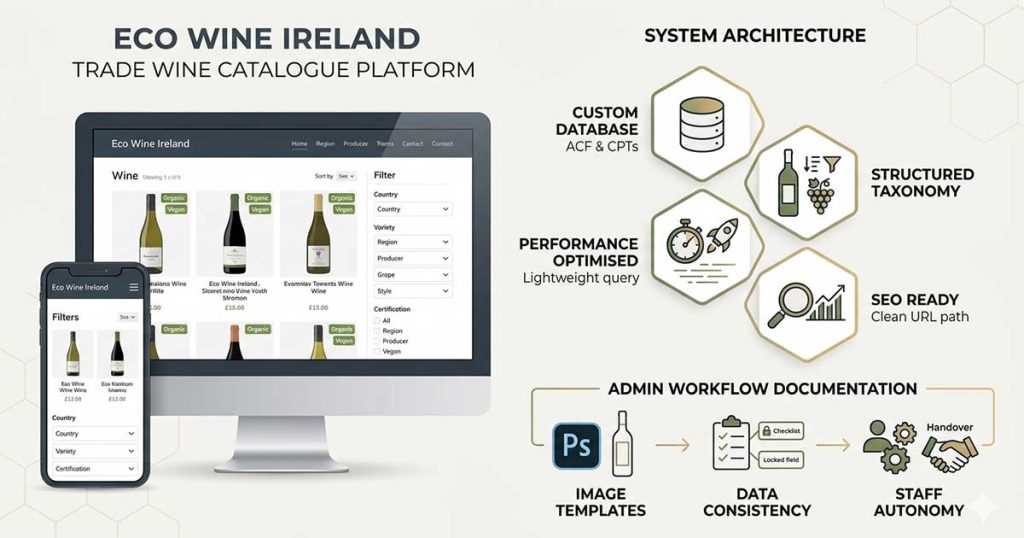
Eco Wine Ireland – Trade Wine Catalogue Platform Case Study
Project Overview
Eco Wine Ireland commissioned me to design and develop a specialist trade-focused wine catalogue platform for the Irish hospitality and retail market. The objective was to create a professional, highly searchable online catalogue that would allow trade buyers to efficiently source wines, review tasting notes and access detailed product information for use in wine lists, menus and purchasing decisions.
The project required far more than a standard brochure website or WooCommerce catalogue. The platform needed to function as a structured wine database tailored specifically to the workflow of restaurants, bars, hotels, retailers and hospitality buyers.
The final result was a custom-built WordPress platform that combines advanced taxonomy architecture, custom content management systems, SEO-focused site structure and a highly usable front-end experience.
Website: Eco Wine Ireland
The Challenge
Eco Wine’s portfolio contains a broad range of wines from multiple countries, producers, regions and grape varieties, alongside sustainability certifications such as:
- Organic
- Biodynamic
- Vegan
- Traditional
Trade customers needed to be able to quickly locate wines based on multiple criteria including:
- Country
- Region
- Producer
- Grape variety
- Certification
- Wine style
- Food pairing suitability
- Tasting notes
- Vintage and classification
The challenge was to present a complex and growing catalogue in a way that remained intuitive, fast and commercially useful.
In addition to the customer-facing experience, Eco Wine required a backend administration system that would allow staff to easily maintain and expand the catalogue while preserving consistency, searchability and SEO quality.
The project also required the website to function as an ongoing business resource rather than simply a product catalogue. This included integrating a news and articles section that allows Eco Wine to publish wine-related content, educational resources and industry articles to support SEO growth and generate additional web traffic over time.
The news section also acts as a customer support resource centre containing guidance on how to use the platform, enabling Eco Wine to direct hospitality clients to relevant guides, browsing instructions and wine discovery resources when responding to customer queries.
My Role
I managed the project from initial planning and information architecture through to development, deployment and administrative workflow design.
My responsibilities included:
- Website planning and architecture
- Wine image preparation and optimisation
- Brand logo preparation and standardisation
- Photoshop-based image processing workflows
- SEO strategy and content structure
- WordPress development
- Custom plugin development
- Advanced custom field implementation
- Wine taxonomy and categorisation systems
- Backend administration workflows
- Search and filtering systems
- Performance optimisation
- User experience design
- Content management guidance documentation
The platform was designed from conception with long-term scalability and search engine visibility in mind.
Technical Approach
Custom Content Architecture
Rather than relying on generic WooCommerce product structures, I designed a fully customised content architecture specifically for the wine industry.
Using Advanced Custom Fields, custom post types and bespoke plugins, I created a structured catalogue system capable of managing detailed wine data while remaining easy for administrators to maintain.
Each wine entry was designed to support:
- Producer information
- Appellations and classifications
- Country and regional metadata
- Sustainability credentials
- Vintage data
- Tasting notes
- Food pairing suggestions
- Technical wine specifications
- SEO metadata
- Internal catalogue relationships
This structure enabled the platform to function more like a specialist wine database than a conventional product catalogue.
The site also incorporates a dedicated news and resource system allowing Eco Wine to publish:
- Wine news and articles
- Producer features
- Educational wine content
- Hospitality-focused resources
- User guides and support documentation
- SEO-focused editorial content
This content architecture provides ongoing opportunities for organic traffic growth while positioning the website as an industry resource rather than solely a catalogue platform.
Dynamic Wine Information System
A key custom feature developed for the platform was a dynamic wine information and short description system designed specifically for trade usability.
Rather than relying on manually written excerpts or inconsistent product summaries, I created a custom-generated information block that dynamically assembles key wine attributes and metadata into a structured above-the-fold summary.
This system ensures every wine is presented consistently and clearly while significantly reducing administrative duplication.
The dynamically generated information includes elements such as:
- Producer
- Region
- Country
- Grape variety
- Wine style
- Sustainability certifications
- Vintage information
- Key wine attributes
Each individual element within the summary is fully clickable, allowing users to instantly browse related wines from the same:
- Producer
- Region
- Grape variety
- Country
- Certification category
- Wine style
This creates a highly interconnected browsing experience that improves product discovery, encourages deeper catalogue exploration and supports trade buyers in comparing related wines efficiently.
The feature also improves catalogue consistency, ensures critical information is always visible above the fold and strengthens internal linking throughout the platform for both user experience and SEO value.
Advanced Taxonomy & Filtering Systems
One of the key development challenges was creating a taxonomy structure that would allow wines to be discovered through multiple pathways.
To achieve this, I developed custom categorisation systems and filtering logic that allow users to browse wines by:
- Certification type
- Country
- Grape variety
- Wine style
- Producer
- Region
- Colour
- Sparkling vs still
- Organic and biodynamic status
This created a highly navigable catalogue that supports both exploratory browsing and targeted product sourcing.
Examples include:
- Organic wine category pages
- Biodynamic wine listings
- Country-specific collections
- Grape-specific landing pages
- Producer archives
These category structures also created valuable SEO landing pages capable of ranking for highly targeted wine-related search queries.
SEO Strategy & Search Visibility
SEO was integrated into the project from the earliest planning stages.
The site architecture, URL structure, taxonomy hierarchy and internal linking systems were all designed to support organic search visibility.
Key SEO considerations included:
- Clean semantic URL structures
- Structured wine categorisation
- Crawlable taxonomy archives
- Optimised metadata structures
- Internal linking strategy
- Fast-loading page templates
- Mobile-first responsiveness
- Search-focused content architecture
- Schema-friendly structured content
Rather than creating a flat product catalogue, the website was intentionally designed to generate multiple layers of searchable and indexable content.
For example:
- Country pages target country-specific wine searches
- Grape pages target varietal searches
- Certification pages target sustainability-focused queries
- Producer pages support branded search traffic
- News articles target informational and educational search intent
- Resource content supports long-tail hospitality and wine-related queries
This approach gives the platform long-term organic search value while also improving user navigation.
The site also employs my preferred white label Automated Metadata Generator system to assist with SEO optimisation and metadata consistency across the catalogue and editorial content.
How the system was structured (simple breakdown)
- Content model: wines structured using consistent attributes (producer, region, grape, certification)
- Navigation logic: users can browse by country, producer, wine type and attributes
- Data consistency: key wine details surfaced above the fold across listings
- SEO structure: pages built around clear topic clusters and internal linking
- AI readability: content designed so systems can interpret and summarise wine attributes reliably
Custom Plugin Development
To support the specialised functionality required by the project, I developed custom WordPress functionality tailored specifically to Eco Wine’s operational needs.
The custom development included:
- Plugin – Widget to display random products based on Attributes
- Plugin – Widget to display random products based on Category
- Plugin – EcoWine Admin User Guide (PDF)
- Wine data management systems
- Wine image display and formatting systems
- Producer logo integration
- Eco credential assignment workflows
- Custom archive templates
- Wine relationship handling
- Administrative utilities
This bespoke approach ensured the website remained lightweight, maintainable and purpose-built for the client’s workflow rather than overloaded with unnecessary third-party plugins.
Backend Administration Experience
An important aspect of the project was designing an administration system that could be efficiently managed by the Eco Wine team.
I created a structured backend workflow with detailed guidance documentation explaining:
- How to add wines
- How to prepare and upload wine bottle images
- How to prepare and optimise producer logos
- How to use supplied wine bottle image templates
- Image sizing and formatting standards
- How to add producers
- How to assign eco credentials
- How to structure tasting notes
- How to maintain SEO consistency
- How to categorise wines correctly
- How to maintain archive quality
- How to publish news articles and resource content
- How to use the website as a customer support resource
The objective was to reduce training overhead while ensuring long-term catalogue consistency.
As part of the onboarding process, I also produced detailed image preparation guidelines and reusable bottle image templates to ensure visual consistency across the catalogue. This included Photoshop-based workflows for preparing wine bottle cut-outs, standardising dimensions, optimising transparency and formatting producer logos for web use.
The admin experience was intentionally designed to make complex catalogue management accessible to non-technical users.
WooCommerce & Backend Systems
The platform uses WooCommerce as the core catalogue management system, configured to support the operational requirements of a specialist wine importer and distributor.
Key backend functionality includes:
- WooCommerce-powered wine catalogue management
- WooCommerce Brands integration to display vineyard and producer information throughout the website
- Structured producer archive systems for hospitality users researching wine origins and producers
- Mail logging systems to record customer enquiries and newsletter subscriptions
- Contact Form Anti Spam Features – Turnstile (Cloudflare’s CAPTCHA alternative) plus Honeypot
- Integrated Google Analytics reporting accessible directly within WordPress admin
- Wordfence security integration for website protection and monitoring
- Advanced caching systems optimised specifically for the hosting environment
- HTTPS encryption as standard across the platform
- White label automated SEO metadata generation systems
The WooCommerce Brands integration significantly enhances the front-end user experience by allowing hospitality users to browse wines by vineyard and producer while improving content structure and internal linking throughout the site.
MailChimp Integration & Email Marketing
The website integrates directly with Mailchimp to manage newsletter subscriptions, list management and email marketing workflows.
The integration includes:
- Automated newsletter subscription handling
- Double opt-in subscription verification
- Audience and mailing list management
- Spam reduction workflows
- GDPR-conscious subscription handling
- Custom MailChimp template development
Double opt-in functionality was specifically implemented to improve subscription quality and reduce spam or low-quality sign-ups.
I also developed a custom-coded reusable MailChimp email template system capable of supporting both:
- Individual promotional campaigns
- Newsletter-style email broadcasts
This provides Eco Wine with a consistent branded email marketing framework while simplifying campaign creation for staff.
Hosting Infrastructure & Performance
The website is hosted on our managed partner hosting platform where we maintain full control over performance optimisation, server configuration and technical support workflows.
Hosting features include:
- 24-hour phone support
- Infinite bandwidth allocation
- 30-day rolling backup retention
- Server-level performance optimisation
- Hosting infrastructure aligned with onsite caching systems
- Security-focused configuration management
The hosting environment was specifically selected to complement the platform’s caching and performance optimisation strategy.
Unlimited bandwidth allocation is particularly valuable for modern SEO and AI-related traffic patterns where websites can increasingly become targets for aggressive crawling, automated scraping and AI learning bots that may consume substantial server resources unexpectedly.
The platform’s caching systems were configured specifically to dovetail with the hosting infrastructure, maximising front-end speed, scalability and reliability.
Compliance & Data Protection
The platform incorporates key compliance and data protection systems including:
- Cookie policy implementation
- Terms & Conditions integration
- GDPR cookie consent management
- Secure HTTPS implementation
- Consent-aware newsletter subscription workflows
These systems were integrated to support modern privacy and compliance expectations while maintaining a smooth user experience.
User Experience Design
The user experience was designed specifically around the needs of hospitality and retail trade buyers.
The platform allows users to:
- Quickly locate wines by category
- Bookmark wines for later review and purchasing decisions
- Compare wines across regions and styles
- Access tasting notes for menu creation
- Browse by eco credentials
- Discover producers
- Review wine specifications efficiently
- Navigate seamlessly across related wines
- Access educational and support resources
- Read wine-related editorial content and news
The interface prioritises clarity, speed and usability while maintaining a clean and professional visual presentation.
Trade customers often work under time pressure, so minimising friction in the discovery process was a key design objective.
The website also functions as a practical support resource for Eco Wine staff, enabling them to direct customers to articles, guides and informational content when responding to queries.
Business Impact
The completed platform provides Eco Wine with:
- A scalable trade catalogue platform
- A structured digital wine database
- Strong SEO foundations
- Improved product discoverability
- Simplified catalogue administration
- Enhanced trade customer experience
- Better presentation of sustainability credentials
- A professional digital presence aligned with the brand
- An ongoing content marketing platform
- A customer support and educational resource hub
The website functions as both a sales support tool and a long-term marketing asset.
Key Features Delivered
Custom Wine Catalogue System
A fully structured wine management platform built specifically for Eco Wine’s portfolio.
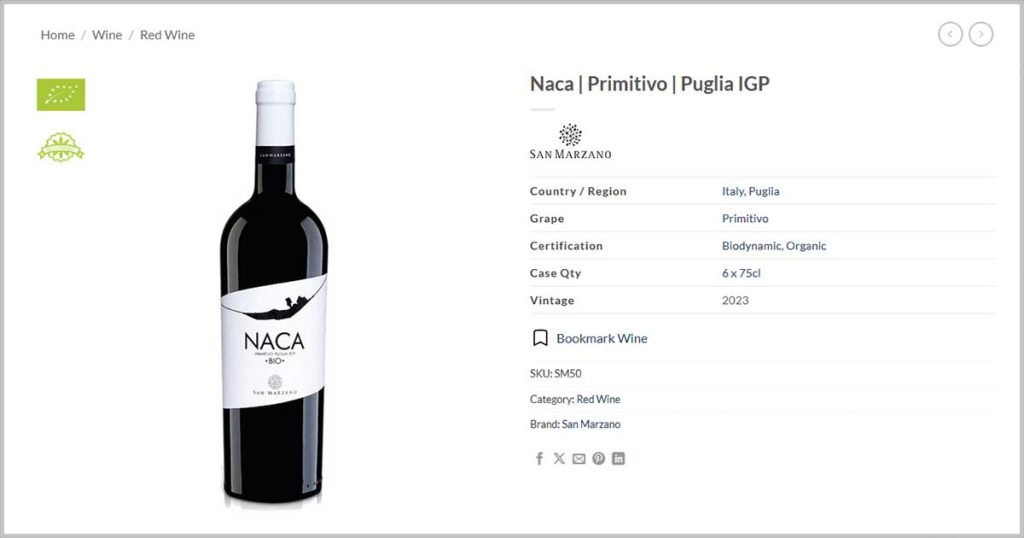
Wine Information Displayed Above The Fold
The solution centers on the product page which features a custom dynamic wine information display positioned above the fold, presenting key wine attributes in a clean, scannable and clickable grid. Built through a customised WooCommerce short description system, the feature automatically generates structured wine data including producer, region, grape variety, vintage and sustainability credentials.
Each attribute is interactive, allowing users to instantly browse related wines, improving discovery and usability for hospitality buyers. The structured layout is also highly AI citation friendly and strengthens SEO through consistent metadata presentation.
From this same area, users can bookmark wines, create shareable wine lists and share products directly via social media and WhatsApp.
Sustainability Credential Overlay System
Sustainability credentials are dynamically overlaid onto relevant wine bottle images using a custom icon system, allowing users to instantly identify Organic, Biodynamic, Vegan and other eco-certified wines through quick visual recognition. This enhances usability for hospitality buyers, improves product scanning speed and reinforces Eco Wine’s sustainability-focused branding throughout the catalogue.
Customer Queries & Engagement
The site encourages and makes it easy for customers to make wine queries regarding orders, availability, wine tasting and so on. The queries are submitted from a single contact form which dynamically adds the originating page / wine to the generated email. Submissions are validated and include unobtrusive anti-spam protection.
Advanced Search & Filtering
Users can discover wines using multiple criteria including grape, region, certification and style.
SEO-Driven Architecture
The entire platform structure was designed to maximise long-term organic search visibility.
Integrated News & Resource Platform
Editorial content, wine articles and user guidance resources integrated directly into the platform to support SEO and customer engagement.
Scalable Taxonomy System
A flexible content structure capable of supporting ongoing portfolio expansion.
Trade-Focused User Experience
Designed around the workflow of hospitality buyers, restaurants and retailers.
Administrative Workflow Documentation
Internal guidance documentation for managing wines, producers and eco credentials.
Product Display Custom WordPress Development
Bespoke plugins and functionality tailored specifically to the client’s operational requirements. These are used to display random wines on the footer of each page based on Product Attributes (Certification, Country etc) and Product Category. This aids sales, helps customers find new wines and provides rich content for SEO & AI Citation.
Technologies Used
- WordPress
- WooCommerce
- MailChimp
- Contact Form 7 with Anti Spam Features – Turnstile (Cloudflare’s CAPTCHA alternative) plus Honeypot
- Adobe Photoshop
- Advanced Custom Fields (ACF)
- Custom Post Types
- Custom WordPress Plugins
- PHP
- JavaScript
- CSS
- SEO-focused content architecture
- Responsive mobile-first design
Conclusion
The Eco Wine project demonstrates my ability to design and deliver highly customised, content-rich web platforms tailored to specific industries and operational workflows.
Rather than using generic templates or off-the-shelf catalogue systems, I developed a structured digital platform that solves real business problems while also supporting long-term growth, discoverability and maintainability.
The project combined technical development, information architecture, SEO strategy, UX design, hosting optimisation and backend workflow engineering into a single integrated solution.
For businesses requiring more than a standard website — particularly those with complex catalogues, structured content or industry-specific workflows — this project highlights the level of custom development and strategic thinking I bring to web design and development.
Project Link
Related Areas of Expertise
- WordPress Installation & Configuration
- Plugin installation & Configuration
- Custom WordPress Development
- Catalogue, Marketplace & eCommerce Websites
- SEO Architecture
- Advanced Custom Fields Development
- Custom Plugin Development
- Information Architecture
- UX Design
- UX Drag & Drop Builders
- Content Management Systems
- Taxonomy & Filtering Systems
- Performance Optimisation
- Structured Data & Search Visibility
- Hosting Infrastructure Optimisation
- Editorial Content Systems
- Email Marketing Integration
- WooCommerce Catalogue Upload
- Product Title, Description Optimisation, Google Trends
- SEO Audit, Report & Implementation
- Product Image Production, Optimisation, Naming Conventions & Meta Data
- Product Category, Tag, Attribute & Brand SEO Optimisation
- Live Chat & AI Assistant Set Up & Integration
- Google Analytics – Set Up & Integration
- Google Search Console, Sitemaps & SEO Submission
- Google Merchant Center & Merchant Feeds
- Google Ads, FaceBook Ads
- Cloudflare – AI Learning Bot Blocking, Country Blocking & Security Rules
- Stock Image Sourcing
- SME & Start Up – Digital Advice, Product Development & Sourcing, Product Presentation, Adding Value & UPS to differentiate from Multi National Retailers
The Story Behind the Project — In My Own Words
Behind the Code: Delivering the Eco Wine Platform
“When Eco Wine Ireland approached me, they had a clear vision: to create a specialist, trade-focused digital wine catalogue for the Irish hospitality and retail sectors. Rather than building a traditional retail eCommerce store, the goal was to develop a sophisticated, data-rich resource where sommeliers, hotel buyers and restaurateurs could seamlessly source wines, study tasting notes and vineyard information and curate wine lists efficiently.
An equally important requirement was making the wines easy to share both internally within organisations and externally with colleagues, customers and purchasing teams.
The most exciting challenge of the project was the sheer depth and complexity of Eco Wine’s portfolio. Individual wines often carried multiple overlapping attributes simultaneously — organic, biodynamic, vegan, linked to a specific producer and originating from a premium niche region. The challenge was taking this highly layered matrix of information and making it feel completely effortless to browse and search.
The platform needed to feel elegant and lightning-fast on a desktop computer in a hospitality purchasing office, while remaining equally fluid and responsive on a mobile phone when a busy floor manager needed to check stock or review wines on the move.
Hospitality professionals frequently work under tight time constraints, so the user experience needed to respect that reality. If someone needed to quickly locate a biodynamic sparkling Italian wine and retrieve its specifications for a menu update, the platform needed to deliver that information within seconds and with minimal friction.
One of the features I was particularly pleased with was the dynamic wine information displayed on each wine product page. While the presentation appears elegantly simple to the user, behind the scenes it is powered by a metadata-driven architecture.
Rather than requiring the Eco Wine team to manually write and maintain countless product summaries, which inevitably leads to duplication, formatting inconsistencies and administrative overhead, I engineered a system that dynamically generates the summary content directly from the wine metadata itself.
The system automatically assembles information such as:
- Producer
- Region
- Country
- Grape variety
- Wine style
- Vintage
- Case Quantity
- Sustainability credentials
This creates a highly structured, consistent presentation layer that is both user-friendly and highly suitable for modern AI-driven search and citation systems.
What makes the feature particularly powerful is that every element within the summary is fully interactive. If a sommelier clicks a grape variety, producer or organic certification badge, the site immediately displays all related wines within the catalogue. This creates an interconnected browsing experience that encourages discovery without overwhelming the interface.
The platform also allows wines to be shared directly from the product view across major social media platforms and via WhatsApp on mobile devices. Users can bookmark wines into their own shareable wine list, which can then be forwarded internally to colleagues or sent directly to Eco Wine as a purchasing enquiry.
Achieving this level of performance required significant focus on the underlying data architecture. By engineering highly tailored WordPress taxonomies and custom content structures, I was able to keep the platform lightweight, scalable and exceptionally fast. Even complex filtering combinations and dynamically generated internal relationships feel virtually instantaneous to the user, while simultaneously strengthening the site’s SEO structure.
Equally important to me was ensuring the Eco Wine team could confidently manage the platform internally. A digital platform is only truly successful if the client can operate it comfortably day to day, so I invested substantial time simplifying the backend administration workflows.
Alongside the platform itself, I delivered guidance documentation, reusable Adobe Photoshop templates and image preparation workflows. This enabled non-technical staff to confidently upload new wines, maintain visual consistency across bottle imagery and manage structured data entry without requiring ongoing developer support.
Ultimately, the project delivered far more than a catalogue website. It became a high-performance business tool — one that gives trade customers a friction-free experience, provides the Eco Wine team with operational autonomy and creates a scalable digital foundation capable of supporting long-term growth, discoverability and search visibility.”
Independent Review: SEO & AI-Citation Readiness
Platform Evaluation & Indexing Readiness Analysis
As part of the Eco Wine Ireland platform review, the website was assessed from both a traditional SEO perspective and in terms of readiness for modern AI-driven search and citation systems. The overall structure of the platform strongly supports discoverability, semantic understanding, and authoritative indexing by both search engines and emerging AI retrieval systems.
Core Platform Strengths
-
- Topical Focus & Authority
The website maintains exceptionally clear topical focus around organic, vegan, biodynamic, and trade wine supply in Ireland.
- Topical Focus & Authority
-
- Semantic Taxonomy Architecture
Content is organised using meaningful taxonomies including country, producer, grape, certification, wine style, and region, helping search engines and AI systems understand relationships between products and topics. Product and catalogue pages use consistent, attribute-led content structures, improving clarity, crawlability, and semantic relevance.
- Semantic Taxonomy Architecture
-
- Factual Copywriting Alignment
Information is presented in a factual, informative format rather than overly promotional copy, aligning well with the types of content increasingly referenced by AI systems.
- Factual Copywriting Alignment
-
- Trust & Expertise Signals
The site demonstrates strong trust and expertise signals through clear business positioning, trade-focused language, delivery information, and educational wine content.
- Trust & Expertise Signals
-
- Text Accessibility & Simplicity
The platform avoids unnecessary complexity and remains highly text-accessible, ensuring important information is easily interpreted by both traditional crawlers and AI indexing systems.
- Text Accessibility & Simplicity
- Dynamic Above-the-Fold Summaries
Particularly notable is the custom dynamic product summary structure implemented across wine listings. Key wine attributes such as producer, grape variety, region, and certification are surfaced consistently above the fold, creating a highly structured information layer that benefits usability, SEO clarity, and AI content extraction alike.
Technical Audit: SEO & AI-Citation Performance Review
Platform Evaluation & Indexing Readiness Analysis
Executive Summary
A technical evaluation of the live platform configuration confirms that the system architecture is exceptionally well-optimised for both modern search engine optimization (SEO) and artificial intelligence (AI) discovery models. By prioritizing a clean, semantics-first development approach over complex, heavy web frameworks, the platform naturally satisfies the core parameters used by search crawlers and large language model (LLM) scraping bots to determine indexing priority and citation accuracy.
Core Evaluation Criteria
1. Text-to-Code Readability & Content Scraping
AI citation tools and search bots process web pages by stripping visual styling and reading the underlying source text sequentially.
- Observation: The underlying HTML structure presents data in a highly logical, uninterrupted stream.
- Impact: Because product titles, regional data, and structural specifications are served as clean, semantic text rather than being locked inside resource-heavy scripts or unreadable image blocks, LLM crawlers can accurately parse, map, and index the entire product catalogue in milliseconds without data fragmentation.
2. Taxonomy Architecture & Semantic Silos
Modern search algorithms heavily reward websites that organize topical authority cleanly through explicit hierarchical structures.
- Observation: The site utilises clean, descriptive URL paths and fully automated indexable archives (e.g., specific landing pages dedicated solely to individual countries, grape varieties, and organic certifications).
- Impact: Rather than relying on fragile, manual page creation, the system leverages native WordPress capabilities to automatically cast a wide net across search engines. This structure captures highly specific, intent-driven long-tail search traffic seamlessly.
3. Entity Association & Data Integrity
For an AI engine to confidently cite a website as a factual source, it must be able to clearly identify “Entities” (e.g., recognizing that a specific term is a brand, a region, or a product attribute).
- Observation: The above-the-fold product description grid maps key-value attributes in immediate proximity to the product title.
- Impact: This structural pairing completely eliminates data ambiguity. Algorithms can instantaneously associate the correct brand, country of origin, and sustainability credentials with the correct wine, maximizing the platform’s eligibility to be featured directly in automated AI search summaries and overviews.