

Guidance Articles
The Harsh Reality of Pay-Per-Click Advertising for Small Businesses
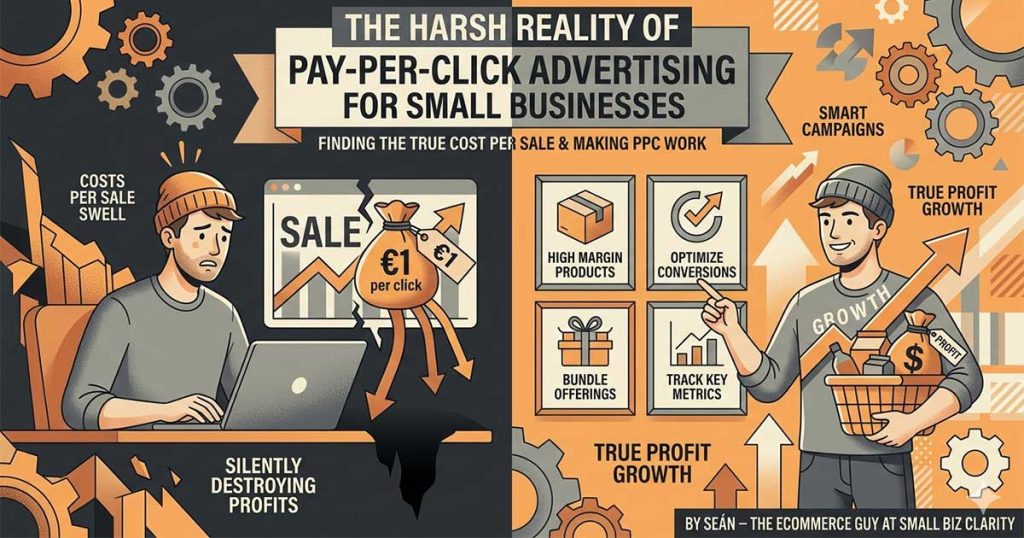
The Harsh Reality of Pay-Per-Click Advertising for Small Businesses
Summary: Pay-per-click (PPC) advertising is often sold as a cheap way to drive sales or build a brand, but the real numbers tell a different story. For low-cost products, even €1 clicks can be a non-starter. This guide reveals the true costs, required margins and practical strategies SMEs can use to make PPC work.
By Seán – The Ecommerce Guy at Small Biz Clarity
Introduction
PPC advertising, whether via Google Ads, Bing, or social media, is frequently presented to small business owners as an easy route to sales. Agencies often frame campaigns as “brand building,” but the reality for SMEs is that each click costs money—and not every click converts into a sale. Understanding the true cost per sale is critical to avoid campaigns that silently destroy profits.
Why PPC Looks Cheap But Often Isn’t
At first glance, €1 per click seems affordable. But with typical conversion rates of 2%, it takes around 50 clicks to generate a single sale. That’s €50 in advertising spend before considering product and shipping costs. As Seán explains:
“A €1 click can cost a small business €50 per sale before you even make a single euro of profit. Many SMEs don’t realise just how quickly advertising costs add up.”
This is why low-cost products are often unsuitable for PPC campaigns unless margins are high or the campaign is heavily optimised.
Typical Numbers for Small Businesses
- Cost per click (CPC): €1 – €2 for low-cost consumer products
- Click-through rate (CTR): ~2% for search ads
- Conversion rate (purchases per click): ~2%
Calculating the True Cost of a Sale
Let’s look at a low-cost product example:
- Product manufacturing cost: €10
- Shipping: €10
- Total product cost: €20
With 2% conversion and €1 CPC:
Ad cost per sale = CPC / Conversion rate
Ad cost per sale = €1 / 0.02 = €50
Total cost per sale = Product + Shipping + Ad cost
Total cost per sale = €10 + €10 + €50 = €70
Required Sale Price for Profit
If you want to make €40 profit per sale, your product must sell for:
Required sale price = Total cost per sale + Desired profit
Required sale price = €70 + €40 = €110
For most SMEs selling low-cost products, this is **simply unrealistic**. This illustrates why PPC for low-ticket items is often a losing proposition.
Mini Case Studies: Low, Mid, and High-Ticket Products
| Product Cost + Shipping | Target Profit | Ad Cost per Sale (CPC €1, 2% conv.) | Required Sale Price | Feasibility for PPC |
|---|---|---|---|---|
| €20 | €40 | €50 | €110 | Very difficult |
| €50 | €50 | €50 | €150 | Possible with optimisation |
| €150 | €100 | €50 | €300 | Feasible |
Practical Options for SMEs
So what can small businesses realistically do?
- Focus on higher-margin products: Only advertise items that can absorb ad costs without losing profit.
- Increase conversion rates: Optimise product pages, landing pages, and checkout processes to boost sales per click.
- Bundle or upsell products: Increase average order value so each sale covers advertising.
- Remarketing campaigns: Lower CPCs and higher conversion rates make returning visitors more cost-effective.
- Use PPC for testing and insights: Run small campaigns to understand which products, messages, or audiences work before scaling.
- Track all metrics: CPC, CTR, conversion rate, cost per sale, and ROI must be monitored consistently.
Key Takeaways
- A €1 click may seem cheap, but with low conversion rates, your “cheap clicks” can cost more than the product itself.
- Low-cost products rarely survive PPC campaigns without careful planning and optimisation.
- Focus on profit margins, conversions, and smart campaigns rather than just generating clicks.
- Understanding your true numbers is critical — otherwise PPC quietly destroys profits.
Seán concludes:
“For most SMEs, low-cost products simply cannot survive standard PPC campaigns. The smart approach is to understand your real numbers, focus on high-margin items, and use advertising strategically rather than blindly chasing clicks.”
PPC can work for small businesses, but only when approached realistically. High-ticket or high-margin products, optimized conversion rates, and smart campaign strategies are the difference between a campaign that destroys profits and one that drives real growth.